
Slow Cooker Cabbage and Potatoes
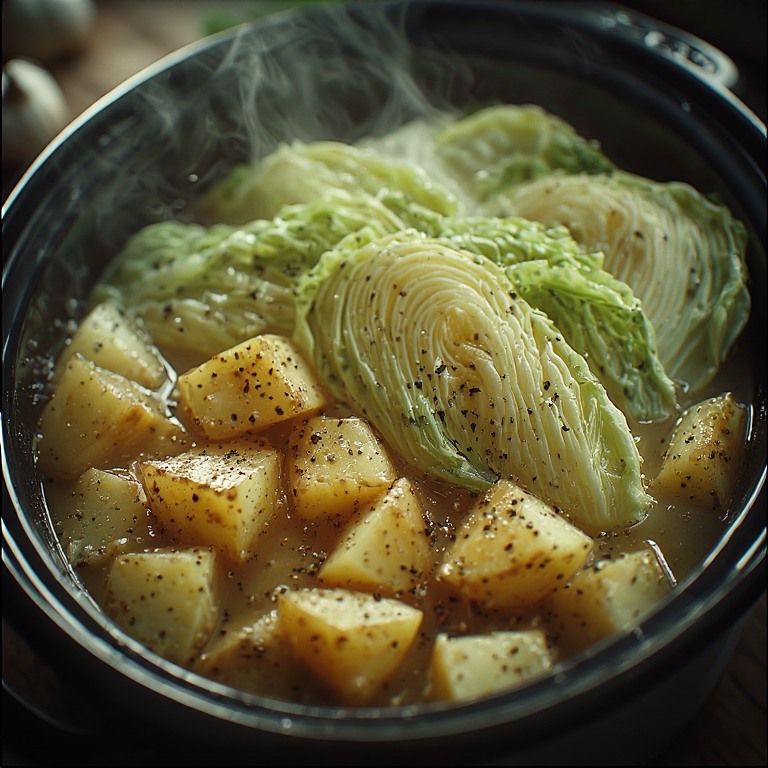
There is a category of dish that feeds people well on almost nothing — and slow cooker cabbage and potatoes belongs to it completely. Four main ingredients: a head of green cabbage, yellow potatoes, a yellow onion, and butter. Water to braise. Salt and pepper to season. That is the whole recipe, and the result after six to seven hours on LOW is a pot of silky, tender vegetables swimming in a golden, buttery broth that tastes like someone spent the afternoon building something considerably more involved. The potatoes soften and absorb the buttery cooking liquid; the cabbage collapses into long, sweet-savory strands; the onion disappears into the broth, contributing its aromatic sweetness; and the whole pot develops the deeply satisfying character that only long, slow, moist cooking can produce from simple ingredients.
This is farmhouse cooking in its most honest form — the kind of dish that sustained households through lean seasons because it required only what could be grown in a kitchen garden and kept in a root cellar, and it worked. It continues to work because the ingredients are genuinely good together, not merely economically convenient. Cabbage and potato have a natural affinity that shows up across dozens of culinary traditions — Irish colcannon, Polish kapusniak, Eastern European potato-cabbage soups, and countless unnamed variations made in farmhouse kitchens across the Midwest for generations. The slow cooker is simply the most hands-off modern method for producing the same result those farmhouse cooks achieved with a heavy pot and a low fire.
Why Cabbage and Potato Work So Well Together
The pairing of cabbage and potato has appeared in cooking traditions across Northern and Eastern Europe and their American descendants for centuries, and there are practical reasons for its persistence beyond mere economy. The two vegetables cook at similar rates under moist heat — both soften and become tender over the same general timeframe, which means they can go into the pot together without one becoming mushy while the other remains firm. They have complementary flavor profiles: potato is starchy, mild, and absorptive, taking on the flavor of whatever it cooks in; cabbage is lightly sweet, slightly sulfurous in the good, earthy way of brassicas, and releases moisture as it cooks that contributes to the braising liquid and flavors everything in the pot. Butter ties the two together — its fat carries flavor throughout the broth, coats each vegetable so the liquid clings rather than pools separately, and adds a richness that makes the finished dish feel properly satisfying despite its simple composition.
The onion is the fourth ingredient that makes the other three more fully themselves. Cooked low and slow in a moist environment, onion slowly breaks down into sweetness — its sharp, pungent raw character is entirely gone after six hours on LOW, replaced by a gentle sweetness that permeates the broth and gives it a layered quality that plain salted water with butter could never achieve. The onion effectively seasons the broth from within rather than contributing a distinct presence of its own, and this is exactly the role it plays best.
Why You’ll Love This Recipe
The cost per serving for this dish is genuinely minimal — cabbage, yellow potatoes, and a yellow onion are among the least expensive items in any produce section, and they keep well, which means this is a recipe that can be made on short notice from pantry and root cellar staples. Despite that economy, the finished dish is not sparse or austere-tasting: the butter and the long slow braise produce a richness and depth of flavor that belies the ingredient cost and preparation effort. It is a complete vegetarian main dish on its own, or an excellent hearty side dish alongside any simply prepared pork, sausage, or chicken. It scales easily for a larger group and holds well on the WARM setting.
Ingredient Notes
Green cabbage — one small head, approximately 2 to 2½ pounds — should be cut into thick wedges with the core left partially intact to hold each wedge together during the long braise. Six to eight wedges from a small head is the right size: large enough to hold their shape through the cook and be served as identifiable portions, small enough to fit comfortably in the slow cooker and cook evenly. The core is tougher than the leaf layers and softens more slowly — leaving it attached keeps the wedge together, but it will be the firmest part of the finished cabbage. For a more evenly tender result, cut a thin sliver off the core tip of each wedge after cooking if it still has some firmness. Savoy cabbage produces a more delicate, sweeter result and cooks slightly faster than standard green cabbage.
Yellow potatoes — two pounds, cut into 1½-inch chunks — go on the bottom of the slow cooker, where they absorb the butter and cooking liquid most effectively. Yukon Gold is the ideal variety: their waxy, medium-starch flesh holds together through the long cook without dissolving into the broth (as a high-starch russet would) while still becoming genuinely tender and creamy in texture. Their natural buttery flavor is also a good match for the butter-rich cooking liquid. Red potatoes are a good alternative with a similar waxy texture. Russet potatoes are not ideal here — they can become waterlogged and begin to disintegrate after 6 to 7 hours on LOW. Leave the skins on Yukon Golds for texture and color; peel if you prefer a cleaner presentation.
Yellow onion — one large, peeled and thickly sliced — contributes aromatic sweetness to the broth throughout the entire cook. Thick slices rather than thin are correct here: after six to seven hours on LOW, thin-sliced onion fully dissolves into the broth and is undetectable as a discrete element, which is fine for flavor but means there’s nothing visually there. Thick slices maintain some presence in the finished dish while still softening and sweetening completely. The onion is layered between the potatoes and the cabbage, where it is in contact with both and can flavor both throughout the braise.
Unsalted butter — six tablespoons, cut into pieces — is the fat that makes the broth rich and cohesive. Six tablespoons is a generous but not extravagant amount for the volume of vegetables — enough to produce a properly buttery, coating broth without making the dish heavy. Distributing the pieces over the cabbage and tucking some down between the vegetables ensures even melting and even fat distribution throughout the broth as it develops. Salted butter can be used — reduce the added salt by half a teaspoon and taste before adding any additional salt at the end.
Kosher salt — two teaspoons — seasons the braising liquid that becomes the dish’s sauce and flavors the vegetables from the outside in during the long cook. Add it before cooking and adjust at the end after tasting — the water reduces somewhat during the braise and the salt concentration increases, so starting at two teaspoons and adjusting is more reliable than estimating the final seasoning before the cook begins.
Water — three cups — is the braising liquid. Three cups brings the liquid level approximately one-third to halfway up the vegetables, which is the correct amount for this application: enough to create a broth and keep the vegetables moist throughout, not so much that it floods the pot and produces a diluted, watery result. As the cabbage and onion cook, they release substantial additional moisture — the finished broth volume will be noticeably higher than what was added at the start. Substituting chicken or vegetable broth for the water produces a more savory, more complex broth that many people prefer; reduce the added salt by half a teaspoon if using broth.
Ingredients
- 1 small head green cabbage (about 2 to 2½ lbs), cored and cut into 6 to 8 thick wedges
- 2 lbs yellow potatoes (Yukon Gold), scrubbed and cut into 1½-inch chunks
- 1 large yellow onion, peeled and thickly sliced
- 6 tbsp unsalted butter, cut into pieces
- 2 tsp kosher salt, plus more to taste
- 1 tsp freshly ground black pepper, plus more to taste
- 3 cups water (or low-sodium chicken or vegetable broth)