
Slow Cooker Amish Meatball Noodles
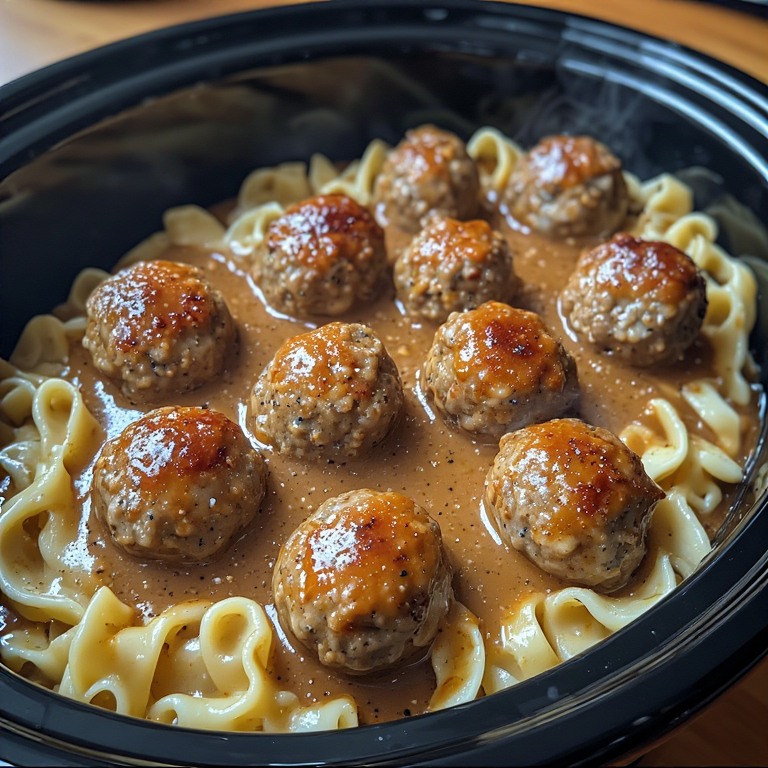
There’s a category of weeknight and weekend cooking where the best possible meal is the one that requires almost nothing from you — where the slow cooker does the work, the house fills with the smell of something savory and warm, and dinner appears at the table fully formed without much more than a stir and a ladle. This slow cooker Amish meatball noodles recipe belongs squarely in that category. Frozen beef meatballs simmer for hours in a rich brown gravy built from condensed beef gravy and beef broth, and then wide egg noodles are stirred in directly to cook in the sauce, absorbing the savory, glossy liquid until they become deeply flavored and tender. Four ingredients, one pot, and very little standing at the stove.
The Amish-style label points to the dish’s roots in Midwestern practical cooking — an approach where pantry-friendly ingredients are used efficiently, the cooking method is straightforward, and the goal is a filling, genuinely satisfying meal for the table rather than anything elaborate or showy. What makes this dish particularly effective is the way the egg noodles cook: added dry to the hot gravy and broth in the final stretch, they absorb the seasoned cooking liquid entirely rather than sitting in separately prepared water, which means every bite of pasta is fully infused with the deep, beefy flavor of the sauce from the inside out.
Why This Recipe Works
The key technique here is cooking the egg noodles directly in the gravy rather than boiling them separately in water. When pasta cooks in plain salted water, it absorbs water — flavorless liquid that has to be compensated for with sauce added after the fact. When egg noodles cook in this beef gravy and broth mixture, they absorb the seasoned, savory liquid itself. The starch released from the noodles as they hydrate also thickens the gravy slightly, pulling it from a pourable liquid to a glossy, clinging sauce that coats each noodle and meatball in the finished dish. The result is a cohesion between the noodles and the sauce that separately cooked pasta can’t achieve — the flavor is in the noodle, not just on it.
The long initial simmer of the meatballs in the gravy is equally important. Frozen fully cooked meatballs need heat to become genuinely warm throughout, but they also benefit from time in the sauce — the condensed beef gravy and broth penetrate the surface of each meatball during the hours of gentle heat, seasoning them from the outside in and creating a more integrated, unified flavor in the finished pot. By the time the noodles go in, the meatballs have given some of their juices to the sauce and absorbed some of its flavor in return.
Why You’ll Love This Recipe
This is genuinely convenient weeknight or weekend food in the best sense. Set it up at noon or in the early afternoon, and dinner is essentially done by early evening with almost no additional work. The slow cooker handles the hours-long braise of the meatballs, and the noodle addition at the end takes 20 to 30 minutes of additional cook time with one brief stir in the middle. Cleanup is a single pot. The dish serves six comfortably from four affordable pantry ingredients, which makes it one of the more economical complete dinners available.
Beyond convenience, it’s the kind of meal that satisfies completely — tender meatballs, wide ribbons of noodle coated in a glossy brown gravy, warm and filling in the way that pasta and sauce in a hearty broth always is. Children and adults respond to it equally well, there’s nothing challenging or unusual about its flavor profile, and it reheats well for the next day’s lunch. It’s the definition of a reliable recipe: not flashy, not complicated, and consistently good every time.
Ingredient Notes
Frozen fully cooked beef meatballs — two pounds — are the protein base of the dish. Using frozen fully cooked meatballs rather than raw or homemade is central to the recipe’s convenience: they go directly into the slow cooker from the freezer without any thawing or pre-cooking required. After several hours in the hot gravy, they are completely heated through, tender, and fully flavored by the sauce. Most supermarkets carry several brands of frozen fully cooked beef meatballs in the freezer section; Italian-style and homestyle varieties both work equally well here, though Italian-style meatballs will add a subtle herbed character to the finished gravy that the homestyle won’t. Choose meatballs that are roughly uniform in size — approximately one inch in diameter — for the most even heating. If you want to develop a deeper, more complex flavor in the sauce, briefly sear the frozen meatballs in a hot skillet with a small amount of oil before adding them to the slow cooker. The browned surface that results contributes fond and caramelization to the cooking liquid that the slow cooker alone can’t produce — it adds about ten minutes to the preparation but makes a noticeable difference to the depth of the finished sauce.
Condensed beef gravy or brown gravy — two standard 10.5-ounce cans — forms the rich, savory base of the sauce. Used straight from the can without diluting first, it thins naturally when combined with the beef broth and the liquid released by the meatballs during the long cook. It provides a ready-made, well-seasoned brown sauce with the consistency and flavor needed to coat the noodles and carry the dish. Most supermarkets stock condensed beef gravy near the soups and condensed broths. Brown gravy, a more generic version of the same product, works identically. If condensed gravy is unavailable, two packets of dry brown gravy mix prepared according to package directions — using beef broth instead of water where possible — can be substituted, though the consistency and depth may differ slightly.
Low-sodium beef broth — two cups — extends and deepens the gravy base. The broth thins the condensed gravy to the right consistency for the long slow cook and provides additional beef flavor throughout the sauce. Low-sodium broth is recommended since the condensed gravy already contains meaningful salt — pairing it with regular-sodium broth can push the finished dish toward uncomfortably salty depending on the brand of gravy. The broth also provides most of the cooking liquid the egg noodles will absorb in the final stage — two cups combined with two cans of condensed gravy is the right total volume to cook twelve ounces of wide egg noodles through to tenderness without leaving the pot dry or overly thick before serving.
Wide egg noodles — twelve ounces, uncooked — are added dry to the slow cooker in the final 20 to 30 minutes. Wide or extra-wide egg noodle ribbons are the traditional choice for Amish and Midwestern noodle dishes; their broad, flat shape holds the thick brown gravy well and gives each bite a satisfying combination of tender pasta and rich sauce. Added dry to the hot gravy, they absorb the flavored liquid as they hydrate rather than diluted cooking water, which is what makes them so distinctively flavorful in the finished dish. Keep a close eye on them during the final cooking stage — egg noodles can go from perfectly tender to soft and mushy fairly quickly in the moist, hot slow cooker environment. Start checking at 20 minutes and taste for doneness: they should be tender throughout but still have a slight chew rather than feeling uniformly soft.
Ingredients
- 2 lbs frozen fully cooked beef meatballs
- 2 cans (10.5 oz each) condensed beef gravy or brown gravy
- 2 cups low-sodium beef broth
- 12 oz wide egg noodles, uncooked