

Step-by-Step Instructions
Step 1 — Grease the Slow Cooker
Generously butter the interior walls and bottom of a 4- to 6-quart slow cooker insert. Use a softened piece of butter or a paper towel dipped in melted butter to coat all surfaces the corn and noodles will contact during cooking. A well-greased insert is important for this recipe: the creamed corn and butter combination can stick firmly to ungreased surfaces during the long cook, and the golden, slightly caramelized edge pieces — one of the dish’s best features — are far easier to serve and the insert far easier to clean when properly greased at the start.
Step 2 — Layer the Noodles
Spread the dry wide egg noodles in an even layer across the bottom of the greased slow cooker insert. The noodles will look like they’re sitting in a dry heap at this stage — this is correct. Spread them as evenly as possible so the corn sauce can reach all parts of the noodle layer rather than saturating a thick pile in the center while leaving the edges dry.
Step 3 — Combine and Add the Corn
In a medium bowl, stir together the drained whole kernel corn and the full can of creamed corn until well combined into a unified corn mixture. Pour this combined corn mixture evenly over the dry noodles in the slow cooker, using the back of a spoon to press the corn down gently into the noodle layer so as much of the liquid as possible is in contact with the dry pasta. It’s fine if some noodle edges stick up above the corn level — those pieces will develop a slightly toasted, chewy quality during the cook that many people consider the best bites in the dish.
Step 4 — Add the Butter
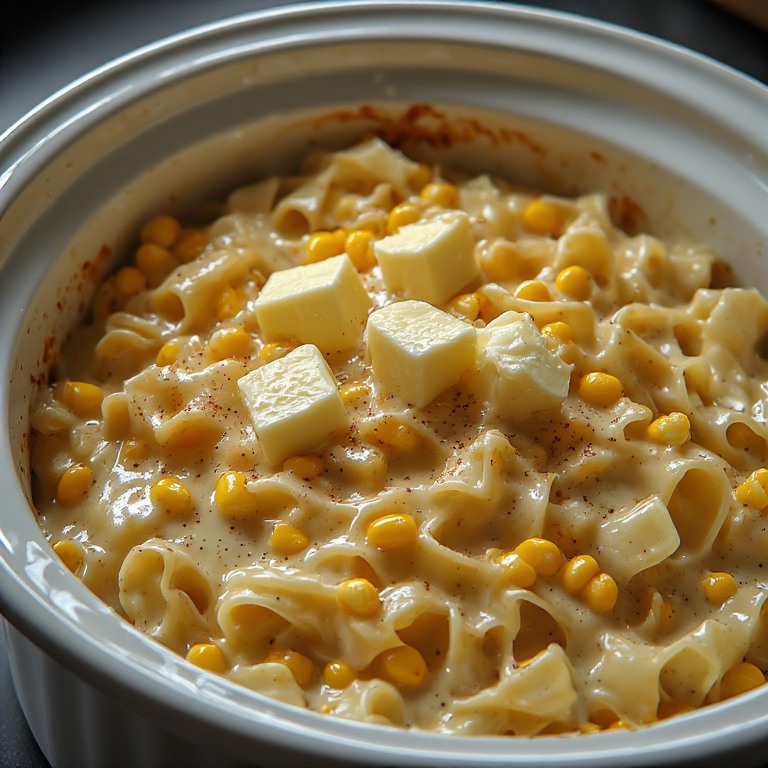
Drizzle the melted butter evenly over the entire surface of the corn and noodle mixture, moving the stream back and forth across the insert to cover as much area as possible. The butter will pool briefly on the surface before beginning to work its way downward as the slow cooker heats. Season the surface with a generous pinch of salt and a grind of black pepper if desired — the creamed corn is already slightly seasoned and the butter unsalted, so a light additional seasoning at this stage is appropriate.
Step 5 — Cook
Cover the slow cooker and cook on LOW for 3 to 4 hours. Do not lift the lid during the first two hours — the steam that builds inside the insert is what cooks the egg noodles through, and releasing it repeatedly prevents the noodles from softening evenly. The dish is done when the noodles are tender throughout with no chalky center remaining when tested, the corn and butter have formed a cohesive, creamy sauce around the noodles, and the edges of the mixture are visibly bubbling and beginning to turn golden where they contact the insert walls.
Step 6 — Fold and Finish
Once the noodles are tender, use a large spoon to gently fold the mixture from the edges toward the center of the insert, incorporating the caramelized edge pieces into the creamier center and distributing the corn and butter sauce evenly throughout. If the top of the dish looks drier than you’d like, replace the lid and cook for an additional 15 to 20 minutes — the noodles will continue absorbing the corn sauce and the dish will become more uniformly creamy. For a more pronounced golden edge throughout, switch to WARM and leave the lid on for an additional 20 to 30 minutes after cooking is complete: the sides will continue to caramelize and deepen in color and flavor while the center stays creamy.
Step 7 — Serve
Drizzle a final tablespoon or two of melted butter over the top of the finished dish if desired — it’s a simple finishing touch that makes each serving look glossy and more appealing. Serve directly from the slow cooker, making sure to scoop from both the edges (for the golden, slightly caramelized noodles) and the center (for the creamiest portions) so each serving captures both textures and flavors.
Tips for the Best Results
Grease the insert generously. This dish is particularly prone to sticking due to the high sugar content of the corn and the butter in the sauce. A thoroughly buttered insert — sides and bottom — prevents the corn from scorching against the walls and makes the golden edge pieces lift out cleanly rather than tearing when served.
Don’t lift the lid in the first two hours. The steam trapped inside the slow cooker is the primary cooking medium for the dry egg noodles. Lifting the lid during the critical first two hours releases the steam and allows the noodles on top to dry out rather than cooking through. After two hours, one or two gentle checks to test noodle tenderness are fine.
If the dish looks dry on top, add a splash of milk. Some slow cookers run hotter than others, and a particularly hot model can cause the top layer of noodles to dry out before the lower layers are fully cooked. If at the two-hour check the top looks dry and the bottom is cooking faster than expected, stir in two to three tablespoons of warm milk or half-and-half before replacing the lid — this adds moisture that keeps the dish creamy through the remainder of the cook.
The edge pieces are intentionally different. The noodles that contact the sides of the insert develop a slightly chewier, more caramelized character than the soft center noodles. This variation in texture is a feature of the dish, not a problem to solve — make sure to serve some of each with every portion.
Fold rather than stir at the end. A gentle fold from the edges toward the center distributes the flavors and textures without breaking the noodles into small pieces. Aggressive stirring at the end can produce a mashed, homogeneous texture rather than the appealing combination of distinct noodle ribbons in a creamy corn sauce.
Frequently Asked Questions
Can I add cheese to this dish?
Yes — it’s a popular and natural addition. Scatter one to one and a half cups of shredded sharp cheddar, Colby Jack, or a Mexican cheese blend over the top of the dish in the final 20 to 30 minutes of cooking, replace the lid, and let the cheese melt into the corn and noodles. The cheese adds a savory, slightly sharp element that contrasts nicely with the corn’s sweetness and makes the dish even more substantial. This is particularly good if you’re serving the corn noodles as a main course rather than a side.
Can I add protein to make it a complete meal?
Yes. Diced cooked ham stirred into the finished dish before serving is the most natural and traditional addition — the salty, slightly smoky ham pairs particularly well with the sweet corn and buttery noodles. Cooked, crumbled bacon scattered over the top at serving adds a crispy, smoky element. Shredded rotisserie chicken stirred in after cooking rounds the dish into a proper main course casserole. Any of these additions work without changing the method.
Can I use frozen corn instead of canned?
Yes for the whole kernel component. Use approximately 1½ cups of fully thawed and well-drained frozen whole kernel corn in place of the canned variety. Do not substitute frozen corn for the creamed corn — the creamed corn’s thick, sauce-like consistency is what cooks the noodles and provides the dish’s characteristic flavor, and frozen corn cannot replicate it. The creamed corn must come from a can.
Can I make this ahead?
Yes. Cook the dish completely, allow to cool, and refrigerate in the insert or in an airtight container for up to 3 days. The noodles will absorb more sauce during storage and the dish will be denser and drier when cold. Reheat covered in the slow cooker on LOW for an hour or so with a splash of milk or cream stirred in to restore the creamy consistency, or reheat individual portions in the microwave covered with a damp paper towel, adding a tablespoon of milk if needed to loosen.
Can I double the recipe for a large crowd?
Yes, in a 7-quart or larger slow cooker. Double all ingredients and extend the cooking time by 30 to 45 minutes, checking for noodle tenderness at the standard time and continuing from there. In a large slow cooker the heat distribution is slightly less even, so stir once at the halfway point to rotate the noodles and ensure even cooking throughout the larger volume.
Variations Worth Trying
Cheddar corn noodles: Add 1½ cups of shredded sharp cheddar in the final 20 to 30 minutes of cooking. Stir half into the dish and scatter the remainder over the top, replace the lid, and let it melt for 15 minutes. The cheese adds a savory, assertive element that gives the dish a more complex, fully seasoned character and pushes it firmly into casserole territory.
Ham and corn noodles: Stir one cup of diced cooked ham into the finished dish just before serving, stirring it through so the ham is evenly distributed throughout the noodles and corn. The saltiness and slight smokiness of the ham plays directly against the sweetness of the corn and produces a genuinely satisfying sweet-savory combination that’s close in character to a classic Midwestern ham and corn casserole.
Jalapeño corn noodles: Add two tablespoons of canned diced jalapeños (drained) or one fresh jalapeño (seeded and finely diced) to the corn mixture before pouring it over the noodles. The heat builds during the long cook and is effectively moderated by the sweetness of the corn and the richness of the butter, producing a subtle, pleasant warmth throughout rather than an aggressive spice that overwhelms the dish’s gentle character.
Herb butter version: Stir two tablespoons of finely chopped fresh chives or flat-leaf parsley into the melted butter before drizzling it over the corn and noodles. The herbs infuse the butter during the cook and add a fresh, slightly grassy note to the finished dish that brightens its flavor and adds color to each serving. A light scatter of additional fresh herbs over the top at serving is a simple and effective garnish.
Sweet version: Increase the butter to six tablespoons and add a tablespoon of honey or light brown sugar to the corn mixture before pouring it over the noodles. Some traditional Amish versions of this dish lean deliberately toward the sweeter end of the sweet-savory spectrum, almost approaching a dessert-adjacent corn pudding character. This version is particularly popular with children and works particularly well as a Thanksgiving or holiday side dish alongside savory roasted meats.
What to Serve Alongside
Amish corn noodles are a generous, rich side dish that pairs best with simply prepared proteins that provide a savory, slightly salty contrast to the corn’s sweetness. Roasted or grilled chicken is the most natural companion — its clean, savory flavor is complemented rather than competed with by the sweetness and butter of the noodles. Pork chops, smoked sausage, baked ham, and meatloaf all work equally well. For a vegetarian meal, a simple green salad with a sharp vinaigrette alongside the corn noodles is satisfying and provides the acidity that balances the dish’s richness. Steamed green beans or roasted broccoli add freshness and a slight bitterness that contrasts pleasantly with the corn’s sweetness. For potlucks, set the slow cooker on the WARM setting alongside a basic garden salad, soft dinner rolls, and a protein main — the corn noodles hold perfectly at serving temperature for up to two hours and serve themselves with minimal effort.
Storage
Leftover corn noodles keep in an airtight container in the refrigerator for up to 4 days. The noodles will absorb virtually all the remaining sauce during storage and become quite dense when cold. Reheat gently on the stovetop in a covered pan or in the slow cooker on LOW with two to three tablespoons of milk stirred in to restore the creamy consistency. Reheat in the microwave covered with a damp paper towel, stirring halfway through and adding a splash of milk as needed. Add a pat of fresh butter to reheated portions before serving — it makes a meaningful difference to the flavor of the leftovers.
Sweet, Buttery, and Gone Before the Party Ends
Slow Cooker Amish Corn Noodles is one of those dishes that proves the most crowd-pleasing food at a potluck table is rarely the most complicated. Four pantry ingredients, minimal preparation, hands-off cooking, and a warm setting that keeps the dish perfect through the entire meal — and what people keep coming back for is the sweet, buttery, creamy noodle dish in the corner that tastes like nothing else on the table. That’s exactly what this recipe delivers, every time.
Enjoy!