

Step-by-Step Instructions
Step 1 — Prepare the Slow Cooker and Chicken
Coat the interior of a 5- to 6-quart slow cooker with nonstick cooking spray or a thin film of oil, covering the bottom and lower sides where the chicken and sauce will be in direct contact with the ceramic insert. Arrange the chicken breasts in a single layer across the bottom of the prepared insert. If any breast is significantly thicker than an inch and a half at the center, slice it crosswise in half to create two more uniform pieces — this promotes even cooking across all the chicken and easier portioning at the table.
Step 2 — Make and Pour the Sauce
In a medium bowl, whisk the two cans of condensed cream of chicken soup and the chicken broth together until the soup is fully dissolved into the broth with no lumps remaining. The mixture should be smooth, uniformly creamy, and slightly thinner than the soup alone but still substantially thick — this is the correct consistency for a braising sauce that will coat and flavor the chicken throughout the cook. Pour the sauce evenly over the chicken breasts, ensuring every piece is fully covered. Some sauce will pool around the edges of the insert, which is correct — this pooled liquid is what hydrates the stuffing layer from below as it heats.
Step 3 — Add the Stuffing
Sprinkle the entire box of dry stuffing mix evenly over the surface of the sauce-covered chicken, distributing it from edge to edge of the insert in as uniform a layer as possible. Do not stir the stuffing into the sauce — it needs to sit on top of the liquid, not in it, so that it can absorb the rising steam and surface moisture gradually and develop the correct fluffy texture rather than becoming immediately wet and dense. The stuffing layer will look dry and raised at this stage, which is correct.
Step 4 — Cook
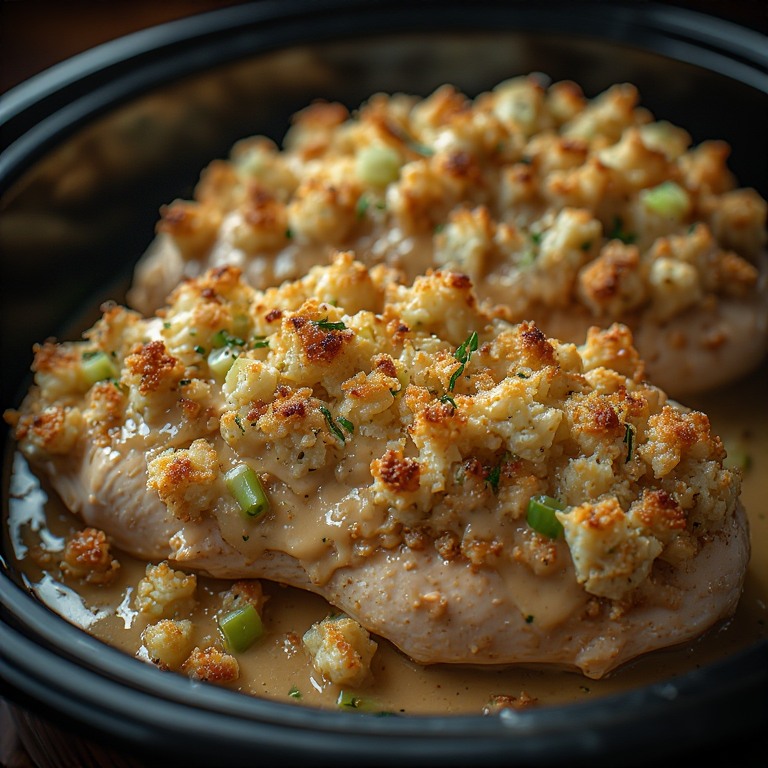
Cover the slow cooker and cook on LOW for 4 to 5 hours or on HIGH for 2 to 2½ hours. LOW is the strongly preferred setting — the gentler, longer cook produces more tender, more evenly cooked chicken and more evenly hydrated stuffing throughout the layer. Do not open the lid during the first 3 hours; the steam trapped inside is doing critical work in cooking the stuffing layer from above. Check at 4 hours: the chicken should be fully cooked through to an internal temperature of 165°F and should feel very tender when pressed with a spoon through the stuffing; the stuffing on top should be moist and fluffy with slightly golden, caramelized edges where it has been in contact with the hot insert walls.
Step 5 — Optional Crisping Step
For more textural contrast in the finished dish — with some slightly firmer, more golden bits of stuffing on the surface alongside the fluffy interior — prop the slow cooker lid slightly open with a wooden spoon handle for the final 20 to 30 minutes of the cook. The escaping steam allows the top surface of the stuffing to dry and color slightly more than the fully covered version. This step is optional but produces a more interesting texture in the finished stuffing layer.
Step 6 — Pull the Chicken and Serve
Once the chicken is fully cooked, use two forks to pull the chicken breasts into large, rustic chunks directly in the slow cooker, folding them gently into the creamy sauce below while keeping the stuffing layer largely intact on top. To serve, scoop deeply through the stuffing layer with a large spoon, capturing stuffing, chicken, and creamy sauce in each portion. Serve immediately while hot, with additional black pepper at the table.
Tips for the Best Results
Do not stir the stuffing into the sauce before cooking. The stuffing needs to sit as a dry layer on top of the liquid to absorb steam gradually and develop proper fluffy texture. Stirring it in at the start produces a uniformly wet, dense, bread-pudding-like result that lacks the textural contrast of the layered version.
Use low-sodium broth. Two cans of condensed cream of chicken soup contain a significant amount of salt. Adding standard-sodium broth to this base reliably produces an oversalted finished dish. Low-sodium broth keeps the total salt content within a range that can be adjusted at the table rather than being locked in too high from the start.
Check the chicken’s internal temperature, not just the clock. The correct doneness indicator for chicken is 165°F internal temperature, not a specific number of hours. Chicken breast thickness varies enough between packages that the same timing can produce undercooked chicken in a thick batch and overcooked in a thin one. An instant-read thermometer inserted into the thickest part of the largest breast gives a definitive answer in seconds.
Scoop from the bottom when serving. The creamy sauce accumulates at the bottom of the slow cooker beneath the stuffing and chicken. A deep, scooping serving motion that goes through the stuffing layer into the sauce below ensures each portion gets all three components — stuffing, chicken, and sauce — rather than a dry serving of stuffing from the top with most of the sauce left in the pot.
For a slightly crisped top, crack the lid in the final stretch. Propping the lid slightly ajar for the last 20 to 30 minutes allows steam to escape and the stuffing’s top surface to dry and color. This produces a more varied texture across the stuffing layer — some fluffy interior sections, some slightly firmer, golden surface bits — that most people find more interesting than a uniformly soft result.
Frequently Asked Questions
Can I use chicken thighs instead of breasts?
Yes — and many people prefer the result. Boneless, skinless chicken thighs are fattier and more forgiving of extended slow cooker cooking than breasts; they can stay on LOW for five to six hours without drying out and produce a richer, more deeply flavored sauce from their higher fat content. The finished thigh meat is also easier to pull into chunks — it separates more naturally than breast meat. Use the same quantity (two pounds) and the same method.
Can I add vegetables?
Yes. Diced celery and onion added to the slow cooker beneath the chicken before assembly are the most natural additions — they’re already in the stuffing’s flavor profile and reinforce those aromatics throughout the dish. Frozen peas or diced carrots can be stirred in during the final 30 minutes of cooking, in which case they’ll be tender and well-integrated into the sauce by the time of serving. Sliced mushrooms placed on top of the chicken before the sauce is poured add an earthy depth that’s particularly good with a cream of mushroom substitution.
Can I make this ahead?
Yes. Assemble the dish completely — chicken in the insert, sauce poured over, stuffing scattered on top — cover, and refrigerate for up to 12 hours before cooking. When ready to cook, remove the insert from the refrigerator while the slow cooker base preheats, then cook as directed, adding 20 to 30 minutes to the total cook time to account for the cold start. This make-ahead approach is particularly useful for Sunday dinners where morning prep time is limited.
What can I do if the stuffing looks dry after cooking?
Carefully drizzle 2 to 3 tablespoons of warm chicken broth around the edges of the slow cooker insert — directing the liquid toward the sides where it can work its way under and through the stuffing from the edges rather than collapsing the top surface by pouring directly over it. Replace the lid and allow the dish to sit on WARM for 10 minutes while the additional liquid distributes through the stuffing. This corrects moderate dryness without making the stuffing wet or dense.
How does this differ from the 3-ingredient stuffing pork chops recipe?
The key differences are the protein, the sauce quantity, and the ratio of sauce to stuffing. This version uses two cans of soup thinned with broth — producing a more fluid, pourable braising sauce that the chicken cooks in rather than the thicker, paste-like mixture of the pork chop version. The result is a dish with more sauce relative to stuffing, a soupier consistency overall, and chicken that is fully braised in liquid rather than merely covered by a combined stuffing-soup layer. Both are excellent; this version is saucier and more casserole-like, while the pork chop version produces a drier, more self-contained stuffing layer.
Variations Worth Trying
Cream of mushroom version: Replace one can of cream of chicken soup with one can of condensed cream of mushroom soup. The mushroom soup adds an earthy, savory depth that makes the sauce more complex and interesting without changing the method or the dish’s character. This is the most popular and most recommended variation for anyone who wants a richer-tasting finished casserole.
Lemon and herb version: Add the zest of one lemon and a teaspoon of dried thyme to the soup-broth mixture before pouring it over the chicken. Stir two tablespoons of finely chopped fresh parsley into the finished casserole just before serving. The lemon brightens the creamy sauce and gives the dish a fresher, more distinctly herbal character that contrasts pleasantly with the richness of the cream soup base.
Onion and celery version: Dice one medium yellow onion and two celery stalks and layer them across the bottom of the slow cooker before adding the chicken on top. These aromatics — already present in the stuffing mix’s seasoning — reinforce the savory, herbal character of the dish from below and contribute to the braising liquid in a way that makes the finished sauce slightly more complex. This is one of the most natural expansions of the base recipe.
Cranberry and turkey version: Replace the chicken breasts with two pounds of boneless turkey breast cutlets and stir three tablespoons of whole-berry cranberry sauce into the soup-broth mixture before pouring. The turkey and cranberry combination within the creamy stuffing casserole is an excellent post-Thanksgiving or holiday season variation that puts familiar holiday flavors into a completely unfussy format.
Cheddar and jalapeño version: Stir half a cup of shredded sharp cheddar and two tablespoons of pickled jalapeño slices (drained and roughly chopped) into the soup-broth mixture before pouring. Sprinkle an additional quarter cup of cheddar over the stuffing layer before the lid goes on. The sharp cheese and mild jalapeño heat give the dish a more assertive, spicier character that shifts it from classic Midwestern comfort food toward something with more edge — popular with households that prefer a little heat.
Serving Suggestions
Chicken and stuffing casserole is a complete meal in itself, and the sides that work best alongside it are simple, fresh, and slightly acidic — chosen to provide contrast to the creamy, savory richness of the casserole rather than to add more of the same qualities. A green salad with a sharp vinaigrette is the ideal accompaniment: crisp lettuce, a bright dressing, and nothing else needed. Steamed green beans with lemon butter, roasted asparagus, or simple sautéed spinach all provide the green vegetable element without competing with the casserole’s flavors. Roasted carrots or corn on the cob are good choices for households with children who prefer familiar, mild vegetables. Dinner rolls alongside are excellent for mopping up the extra sauce in the bowl — which is the best part of the dish and should not be left behind. For a Sunday dinner presentation, bring the slow cooker directly to the table on a trivet set to WARM and let guests serve themselves, which is both the easiest and the most convivial way to serve a dish of this style.
Storage
Store leftover chicken and stuffing in an airtight container in the refrigerator for up to 3 days. The stuffing absorbs more of the sauce during storage and the leftovers will be thicker and more compact than the freshly made dish. Reheat in a covered baking dish in the oven at 325°F for 15 to 20 minutes, adding a few tablespoons of chicken broth to restore moisture, or reheat in the microwave at medium power, covered, stirring once during heating. Freeze individual portions for up to 2 months — thaw overnight in the refrigerator and reheat as above, adding extra broth to compensate for the moisture absorbed during freezing and thawing.
Four Ingredients, One Casserole Worth Repeating
Slow Cooker Chicken and Stuffing Casserole is a recipe that earns its place in the regular rotation by producing a genuinely satisfying, complete dinner from ingredients that require no advance preparation and cost very little. The technique of layering dry stuffing over a liquid sauce base in a covered slow cooker is what transforms four ordinary pantry items into something with real depth and cohesion — the steam does the work that no amount of stirring could accomplish. Set it up in the morning, serve it in the evening, and the casserole arrives at the table tasting like something that required considerably more of the cook’s afternoon than it actually did. That kind of reliable, hands-off result is exactly what a good slow cooker recipe should deliver.
Enjoy!