
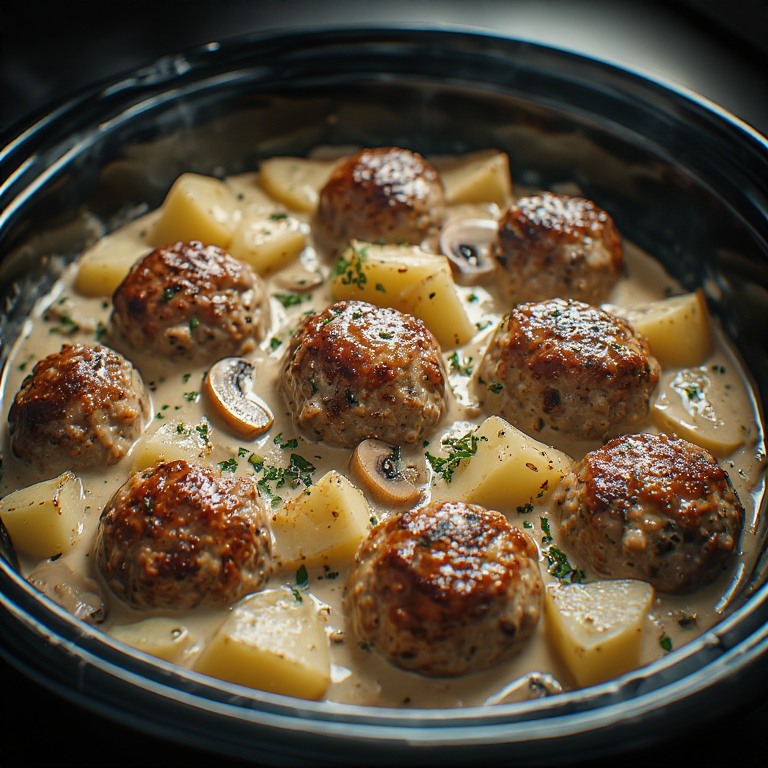
Slow Cooker Amish Meatball Stew
A proper stew depends on a few things working together: meat with enough substance to carry its own weight in the broth; potatoes or another starch to absorb the liquid and give the pot body; and a sauce or gravy that ties both together into something cohesive rather than merely wet. This five-ingredient slow cooker version achieves all three from almost no active kitchen effort: frozen fully cooked meatballs layered over raw cubed potatoes, covered in a sauce made from condensed cream of mushroom soup, beef broth, and dry onion soup mix, and cooked low and slow for six to eight hours until the potatoes are completely tender, the meatballs are plump and saturated with the gravy, and the starch released by the potatoes during the long cook has thickened the sauce into a rich, spoonable gravy that coats every piece.
The layering order matters for specific reasons. Potatoes on the bottom keep them in direct contact with the slow cooker’s heat throughout the entire cook — they need the most time and the most direct heat to cook through to the center. The sauce mixture poured over the potatoes before the meatballs are added ensures the potatoes are surrounded by the seasoned liquid from the start, absorbing the mushroom and onion soup flavor into every cube. The frozen meatballs placed on top thaw gradually during the first hour or two of the cook and then heat through in the rising temperature of the braise, releasing their own seasoning into the sauce as they warm — this exchange of flavors between the meatballs and the surrounding sauce during the long cook is what produces a sauce that tastes like it was made specifically for the meatballs rather than assembled from pantry ingredients.
The Sauce: Three Ingredients That Work as One
The sauce in this recipe — condensed cream of mushroom soup, beef broth, and dry onion soup mix — is a combination that has appeared in Midwestern and American home cooking since all three products became widely available in the 1950s and 1960s, and its persistence is entirely justified by the results. Each of the three components contributes something specific that the other two cannot provide.
Condensed cream of mushroom soup, used undiluted, provides the creamy, slightly thick sauce body and the mushroom-forward savory flavor that is the sauce’s backbone. Used straight from the can rather than diluted, it produces a sauce with the right consistency to coat potatoes and meatballs rather than thin out into a broth. Beef broth provides the savory, beefy liquid depth that thins the concentrated soup to the right braising consistency and contributes the specifically meaty character that makes the sauce taste appropriate for beef meatballs. And the dry onion soup mix provides concentrated onion flavor, salt, savory seasoning, and additional body through its dehydrated ingredients that, reconstituted in the soup and broth during the long cook, produce a layered, deeply onion-forward gravy that is considerably more complex than plain onion would produce from a fresh start.
Why Frozen Meatballs Work So Well Here
Using frozen fully cooked meatballs rather than raw or fresh is one of this recipe’s genuine practical advantages beyond mere convenience. Fully cooked frozen meatballs are designed to hold their shape under a range of cooking conditions, including the moist, extended heat of a slow cooker braise. They are seasoned consistently throughout (something that can be difficult to achieve with homemade meatballs), and they contribute their own seasoning to the surrounding sauce as they warm. The frozen state at the start of the cook is actually beneficial: the meatballs thaw gradually in the heating slow cooker rather than heating too quickly, which gives them time to absorb the surrounding sauce’s flavors during the thawing phase in a way that pre-heated meatballs would not. By the time they are fully heated through, they have been in contact with the mushroom-onion gravy for the better part of the cook and have exchanged flavors throughout.
Why You’ll Love This Recipe
Five ingredients, five minutes of preparation (cubing the potatoes and whisking the sauce), and six to eight hours of unattended slow cooking produce a complete, hearty stew that serves six generously. The frozen meatballs eliminate the most time-consuming part of traditional meatball preparation — making and browning them from scratch — without sacrificing the characteristic appeal of a meatball stew. The finished dish has genuine depth and richness from the long braise and the combined seasoning of the three sauce components, and the natural thickening from the potato starch released during cooking produces a gravy that is properly coating rather than merely liquid. It is a dinner worth looking forward to.
Ingredient Notes
Frozen fully cooked beef meatballs — two pounds — go in straight from the freezer with no thawing required. The standard supermarket variety (approximately three-quarter-inch to one-inch diameter) is the most widely available and fits the recipe’s proportions well. Larger meatballs (one and a half inch) produce a heartier, more substantial presentation; smaller cocktail meatballs produce a more uniform distribution through the finished stew. Pork, turkey, or chicken meatballs can all be substituted with good results — the sauce accommodates any protein that is fully cooked and seasoned. Italian-style meatballs add a fennel and herb character that shifts the stew slightly toward a more Italian-American profile.
Russet potatoes — two and a half pounds, peeled and cut into one-inch cubes — form the base layer. Russet potatoes are the best choice for this application: their high starch content releases into the braising liquid during the long cook and naturally thickens the sauce, and their texture becomes completely tender and slightly yielding in a way that is ideal for stew. Yukon Gold potatoes can be substituted for a slightly firmer, less starchy result with a more buttery flavor. One-inch cubes are the correct size: small enough to cook through completely in the six-to-eight-hour window, large enough to remain identifiable as distinct pieces rather than dissolving into the sauce.
Condensed cream of mushroom soup — two 10.5-ounce cans, used undiluted — is the sauce’s body and flavor backbone. Two cans for two and a half pounds of potatoes and two pounds of meatballs is the correct proportion for a stew-like consistency — one can would produce a thinner, less coating sauce. Cream of celery or cream of chicken can be substituted for a different but equally good flavor character.
Beef broth — one 14.5-ounce can — thins the concentrated soup to the correct braising consistency and adds beefy depth throughout. Low-sodium beef broth is preferred because the dry onion soup mix contains substantial salt; a standard-sodium broth combined with the soup mix can produce an over-salted finished stew. Taste before adding any additional salt at the end.
Dry onion soup mix — one 1-ounce packet — is the seasoning agent that gives the gravy its concentrated onion flavor, salt, and savory complexity. One full packet is the correct amount for this quantity of liquid and food — it provides sufficient seasoning for the entire stew without being too assertive. Do not add additional salt before tasting; the packet provides substantial salt and the stew may need none.
Ingredients
- 2 lbs frozen fully cooked beef meatballs
- 2½ lbs russet potatoes, peeled and cut into 1-inch cubes
- 2 cans (10.5 oz each) condensed cream of mushroom soup, undiluted
- 1 can (14.5 oz) beef broth (low-sodium preferred)
- 1 packet (1 oz) dry onion soup mix