
Slow Cooker Canned Pea Macaroni
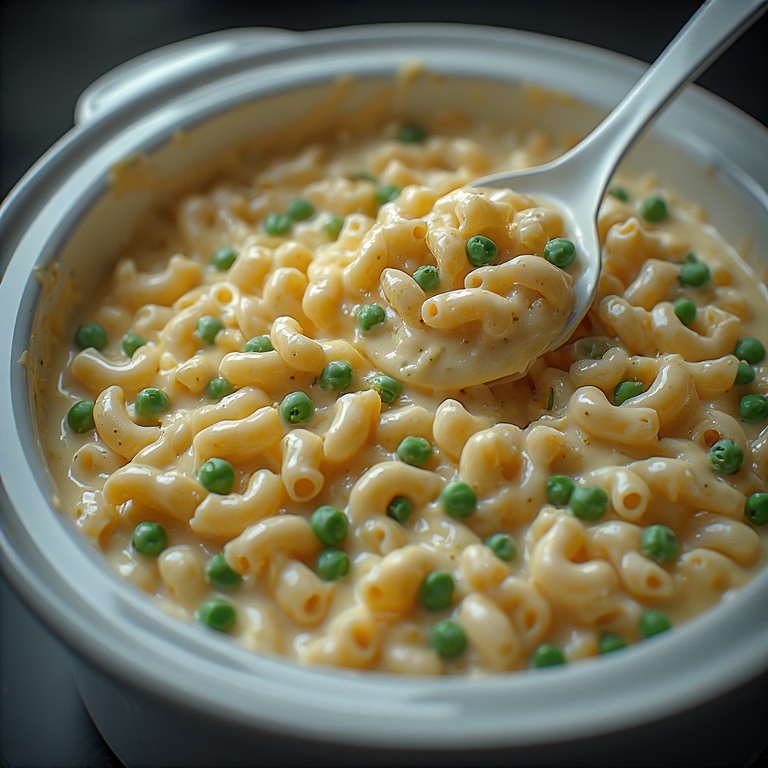
Elbow macaroni, canned peas with their liquid, water, and butter. Four ingredients, one slow cooker, and ninety minutes produce a dish that occupies its own particular category in the American comfort food tradition — the kind of preparation that emerged not from a recipe book but from the practical arithmetic of a Midwestern kitchen where the pantry contained these four things and dinner needed to happen. The pasta hydrates in the combined liquid of the pea brine and water, absorbing the peas’ gentle sweetness as it softens. The butter melts over the surface and works its way through the pasta and peas during the cook. The peas break apart at the edges as everything cooks, their starch blending with the pasta’s released starch and the pea brine into a pale green, glossy, softly coating sauce that clings to every elbow when the pot is stirred. The result is modest in description and genuinely satisfying in the bowl — warm, slightly sweet, buttery, and complete in the way that only very simple food can be.
The use of canned peas rather than frozen is important to this recipe’s specific character and worth understanding. Canned peas are fully cooked and softened in the can, and their brine — the liquid they’re packed in — is mildly seasoned with salt and carries the peas’ flavor throughout. When the peas and their brine go into the slow cooker undrained, they contribute both their soft texture and that flavored liquid to the cooking environment. Frozen peas, by contrast, are firmer and their water content produces a less flavored cooking liquid. The canned pea brine is part of the recipe’s sauce, not a waste product to be discarded, and it is what gives the finished dish its characteristic pale green tint and gently pea-forward flavor throughout every element rather than only where the peas themselves are present.
The Tradition Behind This Dish
Macaroni and peas — pasta e piselli — appears in the Italian culinary tradition as a brothy, simple pasta dish made with fresh or dried peas, olive oil or lard, and occasionally cured pork. The Italian-American adaptation, arriving in the American Midwest through immigrant communities in the early twentieth century, simplified further toward whatever was available: canned peas replaced fresh or dried, butter replaced olive oil, and the preparation found its natural home in the budget cooking of Depression-era and postwar households where four pantry ingredients produced dinner for a family. The slow cooker version is a natural extension of this tradition — the same principles of gentle heat, simple ingredients, and patience producing something more unified and more flavorful than a quick stovetop version of the same dish.
The dish belongs to the broader category of pasta e legumi — pasta with legumes — that encompasses dozens of Italian and Italian-American variations (pasta with beans, pasta with chickpeas, pasta with lentils) all built on the same principle: pasta cooked directly in the legume’s liquid, absorbing its flavor and starch throughout rather than being boiled separately in plain water and sauced afterward. This is why pasta cooked in the pea brine tastes different from pasta cooked in water and tossed with drained peas — the starch exchange during the cook produces something more integrated, more cohesive, and more uniformly flavored throughout every piece.
Why You’ll Love This Recipe
This is one of the most economical hot meals available from a slow cooker. The ingredient cost for four generous servings is minimal. The preparation takes under five minutes. The slow cooker runs mostly unattended for ninety minutes. The finished dish is warm, filling, and genuinely comforting in the specific, understated way that honest budget cooking has always been. For households managing tight grocery budgets, it is a reliable and deeply satisfying solution. For any household, it is the kind of dish that earns a place in the regular rotation precisely because it asks so little and delivers something real.
Ingredient Notes
Dry elbow macaroni — two cups — goes in dry and cooks directly in the pea liquid and water. The small, curved elbow is the traditional and most appropriate shape for this preparation: its size is proportional to the peas so each spoonful has a natural balance of pasta and pea, and its hollow interior catches and holds the thin, buttery pea sauce effectively. Two cups of dry macaroni for the combined liquid of two 15-ounce cans of peas and two cups of water is calibrated to produce a properly sauced result — the pasta absorbs most of the liquid, leaving enough residual liquid to coat every piece without pooling. The HIGH setting is required; LOW does not produce sufficient heat for this thick, starchy mixture to cook the pasta evenly throughout.
Canned peas — two 15-ounce cans, undrained — are the vegetable, the flavoring, and the primary cooking liquid. The brine from the cans is not a byproduct to pour away — it is the seasoned liquid that makes this dish taste more developed than plain pasta cooked in water. Low-sodium canned peas produce a less salty result that may need salt adjusted upward at the end; standard canned peas produce a well-seasoned result with minimal additional salt needed. Any brand of standard canned green peas works identically.
Unsalted butter — half a cup (one stick), cut into pieces — is the fat that creates the sauce’s characteristic glossy, coating quality. Scattered over the top of the assembled pasta and peas, it melts during the cook and incorporates into the pasta and pea starch through stirring to produce the buttery, lightly thickened sauce. Half a cup for two cups of dry pasta is a generous amount that produces a properly rich result. Reducing to one-quarter cup produces a leaner, less satisfying version. Salted butter can be used, but taste before adding any additional salt — the combination of salted butter and canned pea brine may provide sufficient seasoning on its own.
Water — two cups — supplements the pea brine to provide the total liquid the pasta needs to hydrate fully. The two undrained cans provide approximately two cups of combined pea and brine; the two additional cups of water bring the total to approximately four cups for two cups of dry pasta — the ratio that produces the right cooked consistency. Hot water from the tap or a kettle is preferred because it reduces the time the slow cooker spends bringing cold liquid up to cooking temperature.
Ingredients
- 2 cups dry elbow macaroni
- 2 cans (15 oz each) green peas, undrained
- 2 cups water (hot preferred)
- ½ cup (1 stick / 113g) unsalted butter, cut into pieces
- 1 tsp kosher salt, or to taste
- ½ tsp black pepper (optional)