

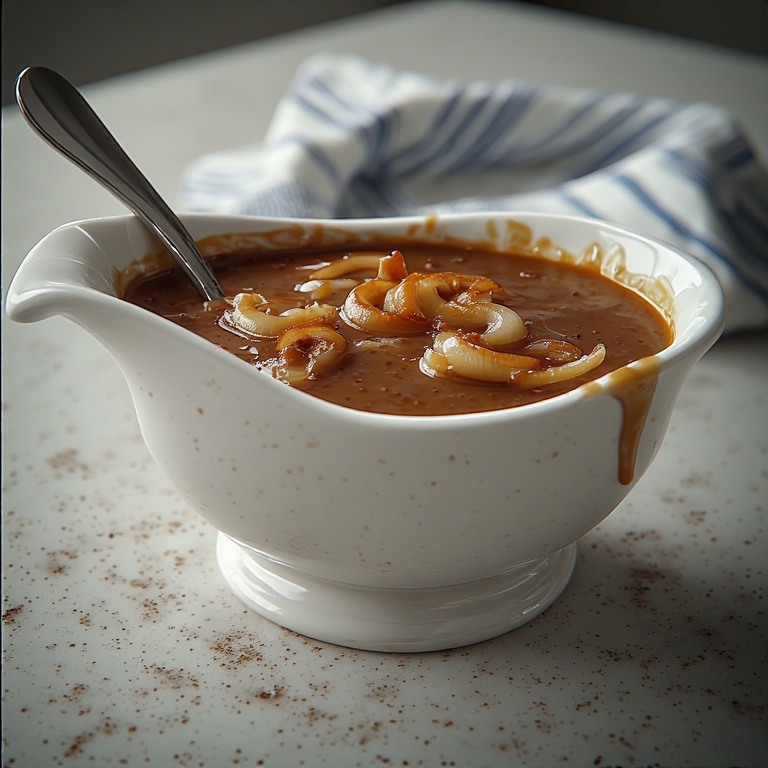
Caramelized Onion Gravy
A good onion gravy is one of the most useful sauces in the home cook’s repertoire — versatile enough to serve over mashed potatoes and roasted meats alike, deeply flavored from properly caramelized onions, and made from ingredients that are reliably on hand. This version takes the time to caramelize the onions properly, which is the step that separates a genuinely excellent onion gravy from a pale, one-dimensional version. The reward for 30 to 45 minutes of patient stirring is a sauce with a deep, sweet-savory foundation that beef broth, Worcestershire sauce, Dijon mustard, and fresh thyme build on to create something layered, fragrant, and far more complex than its ingredient list suggests.
Caramelized onion gravy is particularly associated with British and Irish cooking, where it’s the traditional sauce for bangers and mash, a natural companion to roast meats, and a welcome presence at Sunday dinner alongside Yorkshire pudding. In American home cooking it appears over hamburger steak, pan-fried pork chops, meatloaf, and mashed potatoes, where its richness and depth of flavor make any simply cooked protein taste substantially more special. It’s a sauce that elevates rather than competes, enhancing whatever it’s served alongside without overwhelming it.
The Caramelization Step: Why It Matters
The most important thing to understand about this gravy is that the quality of the finished sauce depends almost entirely on the quality of the caramelized onions. Onions that have been cooked long enough and gently enough to fully caramelize produce a sauce base that’s deeply sweet, complex, and savory in a way that merely softened onions cannot. The difference is the result of two processes happening simultaneously: the sugars in the onion caramelize under sustained heat, producing compounds with a dark, molasses-like sweetness; and the Maillard reaction occurs between the amino acids and sugars in the onion, producing hundreds of new flavor compounds with a nutty, savory, deeply aromatic quality that raw or simply sautéed onions don’t have.
This process genuinely takes time — 30 to 45 minutes for properly caramelized, deep golden-brown onions, depending on the heat level and the thickness of the slices. Shortcuts that promise caramelized onions in 10 minutes produce softened, lightly browned onions that are good but not the same thing. For this gravy, take the time. The slow, patient caramelization is where the sauce’s depth is built, and the broth, Worcestershire, and mustard that go in after are building on that foundation.
Why You’ll Love This Recipe
The finished gravy is genuinely versatile — it improves almost any simply cooked protein or starch that it’s placed alongside. Mashed potatoes with onion gravy pooled over them is one of the most satisfying comfort food combinations available. The same gravy over pan-fried chicken, hamburger steaks, pan-seared pork chops, meatloaf, or bangers transforms a basic weeknight dinner into something more special. It can be made up to three days in advance and reheated gently — in fact, the flavor improves overnight as the thyme infuses further into the sauce — making it practical for both weeknight cooking and dinner parties where some advance preparation is valuable.
The technique is straightforward once you understand the caramelization step. There’s no roux to make without lumps, no stock reduction that requires constant attention, and no difficult technique beyond the patience to let the onions brown properly without rushing.
Ingredient Notes
Butter — six tablespoons — is the fat in which the onions caramelize. Butter adds a dairy richness that oil lacks and contributes to the finished sauce’s color and depth. The butter’s milk solids brown slightly along with the onions during the long caramelization, adding a subtle nutty quality to the base. Using a good-quality butter makes a perceptible difference in the finished sauce — European-style butter with higher fat content produces a slightly richer result.
Yellow onions — two large ones, cut in half and sliced thin — are the soul of the sauce. Yellow onions have the best combination of natural sugar content and sharpness for caramelization — they have enough sugar to develop deep color and sweetness, and enough sharpness that the finished caramelized flavor is complex rather than cloying. Sweet onions like Vidalia are excessively sweet and produce a less complex result; white onions work but have slightly less character. Slicing thin — as thin as you can manage — is important for efficient caramelization: thick slices take significantly longer to cook through and caramelize from raw to golden than thin slices. Slice from root to tip (pole to pole) rather than crosswise, which produces strands that caramelize more evenly as they cook down.
Low-sodium beef broth — two cups — forms the liquid base of the gravy and provides the savory, robust flavor that complements the caramelized onions. Beef broth is the right choice for most applications of this gravy — its depth and richness works naturally with the onion’s sweetness. Low-sodium broth is strongly recommended because the Worcestershire sauce and the natural saltiness of the caramelized onions themselves provide meaningful seasoning; regular broth can produce an over-salted gravy. One quarter cup is reserved separately to mix with the cornstarch, which prevents lumps in the thickening step. For a vegetarian version, a good-quality vegetable broth produces a lighter but still very good result.
Worcestershire sauce — one teaspoon — adds a concentrated, fermented, slightly sweet-sour umami depth that’s immediately recognizable in the finished sauce without being identifiable as Worcestershire specifically. It deepens the savory quality of the broth and adds a subtle complexity that makes the finished gravy taste more developed. A small amount is all that’s needed — one teaspoon contributes meaningfully without dominating.
Dijon mustard — one teaspoon — adds a gentle sharpness and a slightly tangy, complex note that cuts through the richness of the butter and caramelized onions. It functions as a flavor brightener in the finished sauce, keeping it from feeling too heavy, and also acts as a mild emulsifier that helps the butter stay integrated into the broth rather than separating. Dijon’s smooth, wine-flavored sharpness is more appropriate here than the stronger, more vinegar-forward English mustard or the milder yellow mustard.
Cornstarch — 1½ tablespoons — is the thickener. Whisked into the reserved quarter cup of cold broth to form a slurry before being added to the hot gravy, it thickens the sauce cleanly and quickly without the flour taste that a roux-based thickening can produce. Cornstarch-thickened sauces have a glossy, slightly translucent quality that’s particularly attractive in a sauce with visible onion strands throughout. Whisk the slurry into hot (not cold) gravy, add it slowly while whisking, and bring just to a boil for 30 to 60 seconds — cornstarch needs to reach a boil to fully activate and thicken.
Fresh thyme — one tablespoon chopped — is whisked in at the very end of cooking, off the heat or over the lowest heat, so its delicate aromatic compounds don’t entirely cook off before serving. Fresh thyme has a more vivid, floral quality than dried thyme and is the best choice for a sauce served promptly. One teaspoon of dried thyme is an acceptable substitute. Other fresh herbs that work well in this gravy include sage (earthy and slightly peppery, particularly good alongside pork), parsley (fresh and clean, best as a garnish alongside thyme), rosemary (more assertive, good alongside lamb), and chives (mild onion flavor, good as a finishing garnish).
Ingredients
- 6 tbsp unsalted butter
- 2 large yellow onions, cut in half and sliced very thin
- ⅛ tsp kosher salt, plus more to taste
- 2 cups low-sodium beef broth (¼ cup reserved for the cornstarch slurry)
- 1 tsp Worcestershire sauce
- 1 tsp Dijon mustard
- 1½ tbsp cornstarch
- Kosher salt and freshly ground black pepper, to taste
- 1 tbsp fresh thyme, chopped (or 1 tsp dried thyme)