

Step-by-Step Instructions
Step 1 — Grease and Layer the Pasta
Lightly coat the interior of a 4- to 6-quart slow cooker insert with butter or nonstick cooking spray, paying particular attention to the bottom and lower sides where the pasta will have the most contact with the hot surface. Pour the dry bowtie pasta into the prepared insert and spread it into as even a layer as possible across the bottom. The pasta will look like a lot relative to the insert at this stage — it will absorb the liquid and become more compact during the cook.
Step 2 — Make and Add the Sauce Mixture
In a medium bowl or large measuring cup, whisk the chicken broth and condensed cream of mushroom soup together until the soup is fully dissolved into the broth with no visible lumps remaining. The mixture should be smooth and uniformly creamy. Pour it evenly over the dry pasta, working to moisten as many of the pasta pieces as possible. Use a spoon or spatula to gently press down any bowtie pieces sitting on top that are not submerged in the liquid — pasta that cooks without liquid contact will remain hard and chalky in the center while the rest of the dish finishes cooking.
Step 3 — Add the Peas
Scatter the frozen peas evenly over the surface of the liquid-covered pasta. Do not stir — the peas will sink and distribute themselves as the liquid heats and the pasta absorbs the surrounding sauce. A light scatter across the whole surface rather than a pile in the center ensures even distribution in the finished dish.
Step 4 — Cook
Cover the slow cooker and cook on LOW for 2 to 2½ hours. Do not lift the lid during the first 90 minutes — the steam that builds inside the covered insert is doing significant cooking work on the pasta, and releasing it early can result in the pasta taking much longer to cook through or cooking unevenly. Begin checking at the 2-hour mark by gently pressing a piece of pasta with a spoon — it should feel uniformly soft throughout with no hard or chalky center. If there is still firmness at the center of the pasta, cover and continue cooking in 15-minute increments until fully tender. Every slow cooker runs at a slightly different temperature; some may finish in 1 hour 45 minutes, others may take the full 2½ hours.
Step 5 — Add the Parmesan and Finish
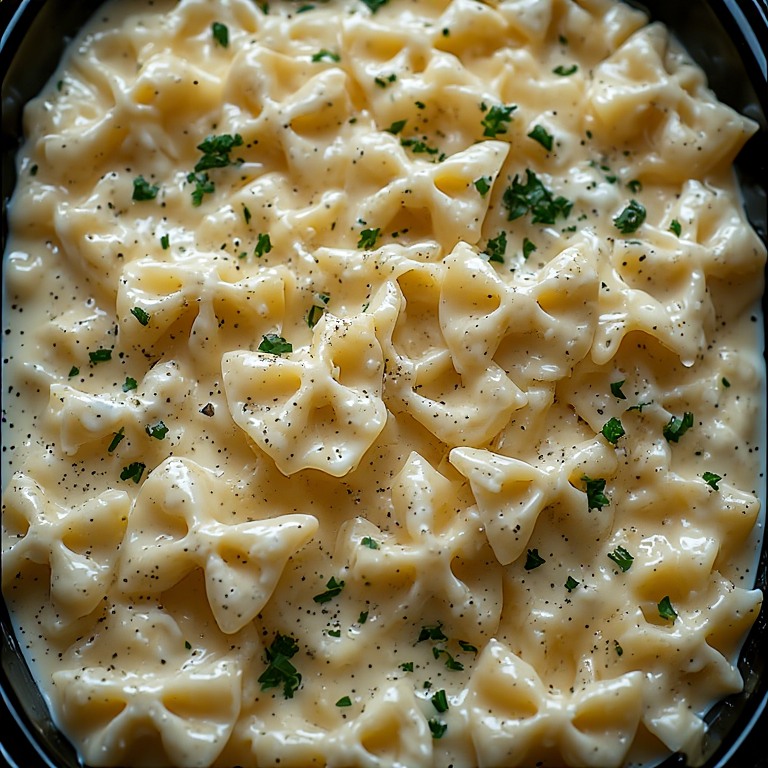
Once the pasta is just tender, quickly open the lid and sprinkle the shredded Parmesan evenly over the top. Replace the lid for 2 to 3 minutes to allow the cheese to begin melting from the residual heat. Then open the lid and use a large spoon to fold the pasta gently from the bottom up, incorporating the melting cheese throughout the dish and combining the pasta, peas, and sauce into a cohesive, creamy mixture. Fold rather than stir vigorously to keep the pasta pieces intact.
Step 6 — Adjust Consistency and Season
Assess the consistency of the finished dish. If it seems loose or soupy, cover and leave on WARM for 10 to 15 minutes — the pasta will continue to absorb the surrounding liquid and the dish will thicken to a proper creamy consistency. If it seems too thick or the pasta has absorbed nearly all the liquid, stir in a splash of warm chicken broth or a spoonful of hot water until the sauce flows freely again. Taste and season with salt and black pepper — the low-sodium broth and the Parmesan together should have provided adequate baseline seasoning, but adjust to preference. Serve immediately with additional Parmesan available at the table.
Tips for the Best Results
Keep the lid on for the first 90 minutes. The steam environment inside the covered slow cooker cooks the pasta from above as well as the liquid cooks it from below. Lifting the lid early dissipates this steam and can result in the top layer of pasta taking considerably longer to cook through than the submerged lower layer. Patience during the first 90 minutes produces more evenly cooked pasta throughout.
Press dry pasta pieces down into the liquid. Any bowtie that sits above the liquid level when the dish goes in will cook dry and remain hard in the center. A brief pass with a spoon before the lid goes on, pressing any high-sitting pasta pieces down into the sauce, ensures all the pasta has liquid contact from the start of the cook.
Check at 2 hours, not before. Slow cooker pasta timing varies meaningfully by slow cooker model and age. Rather than relying on the clock, check the pasta’s actual texture at the two-hour mark and continue cooking in short increments if needed. This prevents both undercooking (chalky, hard-centered pasta) and overcooking (mushy pasta that has lost all its bite).
Fold the Parmesan in gently. Vigorous stirring of fully cooked pasta in a slow cooker breaks the bowtie shapes and produces irregular pieces rather than the intact farfalle shapes that make the dish so visually appealing. A gentle folding motion from the bottom up, turning the pasta over itself two or three times, incorporates the cheese without breaking the pasta.
Have warm broth on hand. A small amount of reserved warm broth is the most useful tool for adjusting the finished dish’s consistency in either direction — a splash loosens a too-thick pasta; allowing the dish to sit on WARM for a few minutes thickens a too-loose one. Keeping a quarter cup of warm broth ready when it’s time to finish the dish means any consistency adjustment takes seconds rather than requiring additional preparation.
Frequently Asked Questions
Can I use a different pasta shape?
Yes, with adjustments. Medium pasta shapes with similar cooking times to farfalle — penne, rotini, medium shells, or ziti — work well with the same liquid quantity and timing. Very small shapes (ditalini, orzo) absorb liquid faster and may be done in 1 to 1½ hours; very large shapes (rigatoni, large shells) may need the full 2½ hours or slightly beyond. Check earlier or later than the standard timing depending on the shape’s size. Egg noodles are not ideal here — they absorb liquid very quickly and tend to become mushy before the sauce is properly developed.
Can I add protein to make it a more substantial main course?
Yes — and several options work very naturally with the dish’s flavors. Cooked, diced ham stirred in along with the Parmesan at the end needs only the WARM setting for 10 minutes to heat through, and its mild, slightly sweet-salty character is a natural partner for the mushroom cream sauce. Shredded rotisserie chicken stirred in at the same stage adds lean protein with minimal effort. Cooked, crumbled Italian sausage adds a more assertive, fennel-forward flavor that shifts the dish’s character in a more distinctly Italian direction. Cooked shrimp stirred in at the very end (it’s already cooked and only needs warming) is an elegant addition for a more special-occasion version.
Can I substitute a different cream soup?
Yes. Cream of chicken soup produces a milder, more neutral-tasting sauce that’s particularly good with ham or chicken added as protein. Cream of celery has a subtler, slightly more vegetal flavor that works well in the spring-vegetable spirit of the recipe. Cream of onion produces a sweeter, more savory result. Any condensed cream soup produces a comparable sauce base — use the same quantity and method regardless of which variety you choose.
What should I do if my slow cooker runs hot?
If your slow cooker is known to run hot — the pasta seems to be cooking faster than the timing suggests, or you notice it bubbling vigorously at the edges — start checking for pasta doneness at 1 hour 30 minutes rather than 2 hours, and switch to WARM as soon as the pasta is just tender. Pasta in a hot-running slow cooker can go from perfectly cooked to overcooked in 15 minutes. Learning how your specific slow cooker behaves is the most useful thing you can do for any slow cooker pasta recipe.
Can I make this ahead?
This dish is best made and served within 30 minutes of finishing — the pasta continues to absorb the sauce during storage and the dish becomes progressively thicker and denser. For a planned-ahead version, cook the pasta until just barely tender (slightly underdone), remove from the slow cooker immediately, and refrigerate in the sauce. Reheat on the stovetop over medium-low heat with a generous splash of broth to restore the sauce, stirring gently until heated through and the pasta has reached the correct texture. The reheated version requires more liquid adjustment than the freshly made dish but is perfectly acceptable for next-day leftovers.
Variations Worth Trying
Ham and pea version: Stir one cup of diced cooked ham into the pot along with the Parmesan at the end of cooking. The ham and peas together echo the classic Italian combination of prosciutto and piselli, and the mushroom cream sauce ties them together into something that feels cohesive and intentional rather than improvised. This is the most natural and recommended protein addition for anyone wanting a more substantial main course from the base recipe.
Lemon and herb version: Stir the zest of one lemon and two tablespoons of finely chopped fresh parsley into the finished pasta along with the Parmesan. A squeeze of fresh lemon juice at the table alongside each serving brightens the creamy sauce considerably and gives the dish a fresher, more distinctly springtime character. Fresh thyme or chives are equally good herb additions for the same brightening effect.
Mushroom and spinach version: Add half a cup of sliced baby bella mushrooms to the slow cooker along with the pasta at the start of the cook. Stir two large handfuls of fresh baby spinach into the finished pasta along with the Parmesan — the spinach wilts into the hot sauce in 60 seconds and adds deep green color and a mild earthy flavor. This version leans more fully into the mushroom character of the cream of mushroom soup and produces a more robustly flavored, vegetable-forward result.
Chicken and broccoli version: Replace the frozen peas with one cup of frozen broccoli florets and add one cup of shredded rotisserie chicken to the pot at the Parmesan stage. The chicken and broccoli combination within a cream of mushroom sauce produces a slow-cooker version of the classic chicken-broccoli-cheese casserole that is familiar and reliably popular for any household with children at the table.
Italian sausage version: Brown half a pound of mild Italian sausage (removed from its casing and crumbled) in a skillet over medium heat until cooked through; drain the excess fat and stir the cooked sausage into the slow cooker along with the Parmesan at the end of cooking. The fennel and herb seasoning of the Italian sausage gives the finished dish a more assertive, deeply savory character that pairs well with the mushroom cream sauce and makes the recipe feel closer to a proper pasta supper than a simple weeknight casserole.
Serving Suggestions
Slow Cooker Springtime Bowtie Pasta is substantial enough to serve as a complete main course with a simple green salad or a plate of sliced cucumbers and tomatoes alongside. The creamy sauce benefits from something slightly acidic and fresh — a lightly dressed arugula salad with lemon vinaigrette, a simple tomato and basil salad, or even just a bowl of cherry tomatoes halved and seasoned with salt and olive oil — to provide the brightness that cuts through the cream. Buttered dinner rolls or garlic toast are excellent for mopping up the extra sauce in the bowl. A sprinkle of additional Parmesan at the table is the simplest and most effective finishing touch. For a more complete potluck-style presentation, serve the bowtie pasta alongside a simple protein — baked chicken thighs, sliced ham, or grilled sausage — and a vegetable side, letting the pasta fill the role of a starchy side dish rather than the sole focus of the meal.
Storage
Store leftover bowtie pasta in an airtight container in the refrigerator for up to 3 days. The pasta absorbs the sauce during storage and the leftovers will be noticeably thicker and denser than the freshly made dish — this is expected. Reheat on the stovetop over medium-low heat, stirring in a generous splash of chicken broth or milk to restore the sauce’s creamy, flowing consistency. Reheat in the microwave at medium power, covered, stirring once halfway through and adding a spoonful of liquid if needed after stirring. The pasta texture will be softer in leftovers than in the freshly made dish; for anyone who prefers a firmer pasta texture in leftovers, slightly undercooking the pasta at the initial cook — removing it from the slow cooker when just barely tender — produces a better reheated result.
Five Ingredients, One Satisfying Bowl
Slow Cooker Springtime Bowtie Pasta demonstrates what a thoughtfully assembled set of pantry staples can produce when given the right method and enough time. The condensed cream of mushroom soup and chicken broth build a sauce with more depth and creaminess than their origins suggest; the peas bring the freshness and color that earn the recipe its name; the Parmesan finishes it into something genuinely rich and satisfying. Five ingredients, two and a half hours, and a result that tastes like someone spent the afternoon building something considerably more deliberate. That is a weeknight recipe worth having.
Enjoy!